
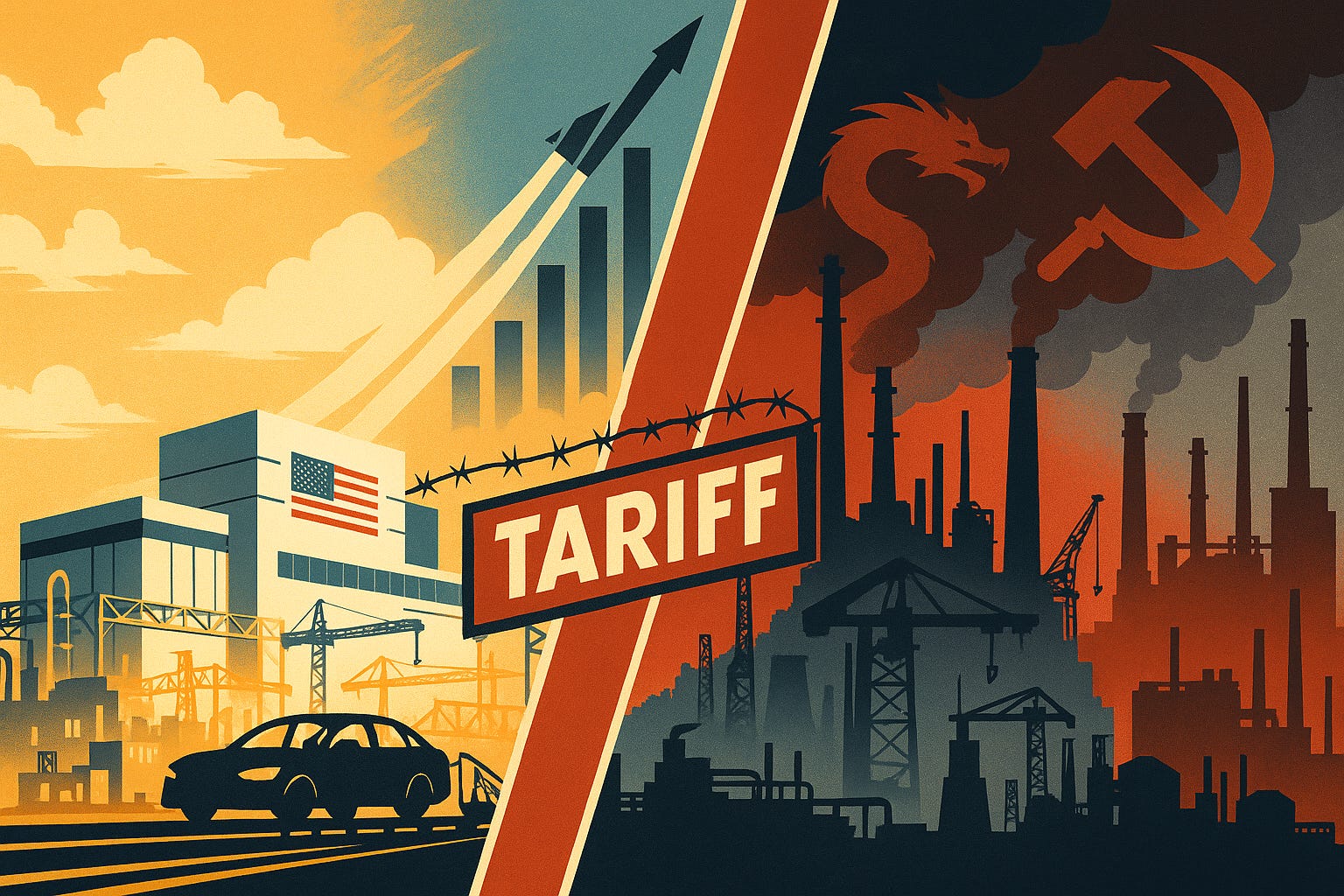
President Trump faces a fundamental contradiction at the heart of his manufacturing revival strategy. His administration has made bringing manufacturing jobs back to America a central promise, backing it with aggressive tariff policies and substantial tax incentives. Yet the very negotiability of these policies—their positioning as temporary measures subject to successful trade deals—may be undermining their effectiveness at attracting the long-term manufacturing investment they're designed to encourage.
This creates what we might call Trump's Manufacturing Dilemma: how can an administration convince companies to make billion-dollar, multi-decade facility investments when the policy framework supporting those investments is explicitly framed as temporary and subject to reversal based on ongoing negotiations?
The Credibility Gap in Current Policy
The challenge becomes clear when examining the scale of modern manufacturing investment. A semiconductor fabrication plant costs $10-20 billion and requires 3-5 years to build. An automotive assembly facility represents similar magnitudes of irreversible capital commitment. These investments only make economic sense if companies believe the policy environment that justified them will persist long enough to generate returns.
But Trump's current approach sends mixed signals. The administration's 2025 Trade Policy Agenda explicitly frames tariffs as tools for negotiation, stating that the United States will "take action to create the leverage needed to rebalance our trading relations"90. This suggests that successful negotiations could lead to tariff reductions—exactly the kind of policy reversibility that makes manufacturers hesitant to commit capital.
The evidence of this uncertainty is already visible. Since Trump's "Liberation Day" tariffs were announced in April, the U.S. has lost 37,000 manufacturing jobs, and manufacturing hiring has dropped to its lowest level since 2016. A Joint Economic Committee analysis found that continued tariff uncertainty could reduce manufacturing investment by $490 billion by 2029.
"Manufacturing firms expected capital expenditures to increase by 5.2 percent in 2025; as of May 2025, they expected them to shrink by 1.3 percent," the analysis notes. The National Association of Manufacturers reports that trade uncertainty is manufacturers' top concern, with optimism dropping to pandemic-era lows.
The NVIDIA Problem
For example, in April 2025, the administration banned NVIDIA’s H20 AI chips to China on national security grounds, only to reverse the ban three months later in exchange for a 15% revenue tax on China sales. This reversal—driven by financial leverage rather than security concerns—undermines the credibility of “national security” justifications. For manufacturers weighing multi-billion-dollar investments, such policy whiplash creates the very uncertainty they seek to avoid. A true Cold War framework would prevent strategic measures from being treated as temporary bargaining chips.
The Cold War Solution: Permanent Competition Framework
This is where a Cold War framing could provide a solution to Trump's dilemma. Rather than positioning trade restrictions as temporary negotiating tools, a Cold War framework would recast them as permanent features of long-term strategic competition with China and Russia. This shift from economic to security justification could provide the policy durability that manufacturers need to justify major capital investments.
Historical precedent supports this approach. During the original Cold War, the United States maintained consistent economic frameworks for decades specifically because they were understood as essential to long-term ideological and security competition. The Marshall Plan, NATO economic integration, and strategic trade controls persisted across multiple administrations because they were viewed as permanent features of superpower competition rather than temporary economic measures.
From Negotiation to Competition
The key insight is that national security imperatives create different political dynamics than economic ones. Economic policies are naturally subject to cost-benefit analysis and negotiation—if tariffs become too expensive or negotiations offer better alternatives, they can be reversed. But security policies operate under different logic: they persist as long as the underlying threat exists.
A Cold War framework would reposition current trade restrictions from "tools for better deals" to "requirements for national survival." Instead of tariffs being contingent on Chinese behavior in trade negotiations, they would be justified as necessary measures to prevent technological dependence on strategic competitors. This transforms policy uncertainty from "Will Trump get a good deal?" to "Do China and Russia still pose security threats?"—a much more durable foundation for business planning.
Institutional Advantages of Security Framing
Research on international trade policy reveals that security-justified measures enjoy greater institutional durability than purely economic ones. Security policies typically receive:
Broader bipartisan support that survives electoral changes
Reduced susceptibility to industry lobbying for case-by-case exemptions
International legitimacy under WTO national security exceptions
Bureaucratic momentum through defense and intelligence agencies rather than trade-focused departments
The Trump administration has already experimented with this approach through Section 232 "national security" tariffs on steel and aluminum, but applied it inconsistently. A comprehensive Cold War framework would systematize this logic across the entire trade relationship with strategic competitors.
The Manufacturing Investment Logic
From a manufacturer's perspective, a Cold War framework would provide several crucial advantages:
Policy Predictability
Companies could plan investments based on the assumption that strategic competition with China will persist regardless of electoral outcomes or short-term diplomatic developments. This removes the current uncertainty about whether policies will survive changing political priorities or successful negotiations.
Escalation Clarity
Rather than wondering whether tariff rates might suddenly drop if negotiations succeed, manufacturers could anticipate that restrictions would likely increase over time as strategic competition intensifies. This creates incentives for early domestic investment before policies tighten further.
Supply Chain Security Mandates
A Cold War framework would likely include explicit requirements for defense contractors and critical industries to maintain domestic supply chains, creating guaranteed demand for U.S.-based manufacturing facilities regardless of cost competitiveness.
Long-term Government Commitment
Security-justified industrial policies typically receive more sustained government support, including not just trade protection but also R&D funding, infrastructure investment, and regulatory accommodation.
Conclusion: From Negotiations to Competition
Trump's manufacturing dilemma reflects a deeper tension between the short-term politics of deal-making and the long-term economics of industrial investment. Campaign promises about "great deals" that will restore normal trade relationships may sound appealing to voters, but they create exactly the kind of policy uncertainty that prevents the manufacturing investment those same voters want to see.
In adopting a Cold War framework, the administration would shift toward permanent security tariffs on strategic imports, integrate trade and industrial policy under the National Security Council, and offer multi-decade investment guarantees tied to defense requirements. We would see coordinated economic measures with NATO and Indo-Pacific allies, enforceable mandates for domestic supply chains, and standardized compliance rules replacing discretionary exemptions.
Published escalation roadmaps would guide investors, while expanded WTO national security exceptions and multistakeholder oversight councils would bolster policy durability. Finally, expect ongoing federal investment in chip fabs, advanced materials, and other defense-critical infrastructure—ensuring that U.S. manufacturing capacity evolves not on market cycles but in lockstep with long-term strategic competition.
How likely is Trump to take this path? Time will tell.