
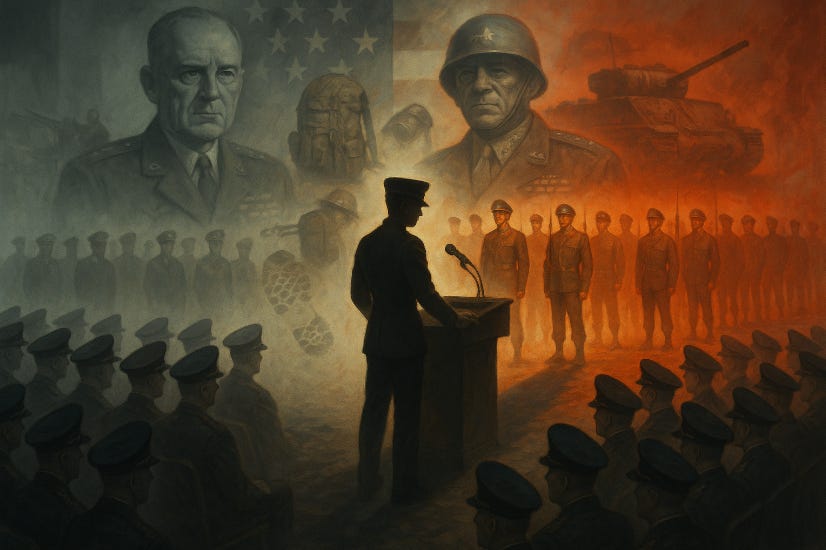
Hundreds of senior officers were summoned last week by Secretary of War (SECWAR) Pete Hegseth (formerly the Secretary of Defense) to Quantico Virginia for a speech. In the speech, the SECWAR introduced the senior leadership of the U.S. military to the newly rebranded War Department (formerly the Department of Defense) and to ten new directives he was issuing to the U.S. military.
In it he offered a vision of the administration’s goals for the War Department.
“You see, the motto of my first platoon was those who long for peace must prepare for war.”
Now, more than a week later, reviews of the speech have come in from all parts, highlighting, obscuring, and taking issue with various parts of the speech.
The New York Times ran a guest opinion piece titled “That Hegseth Speech Was Actually Pretty Good” Source
In the Wall Street Journal former Reagan speechwriter, Peggy Noonan, offered “The Embarrassing Pete Hegseth” Source
Let’s see if we can unearth some ideas that might be buried in the speech.
The Directive: Standards are In - “DEI” is out
The SECWAR’s core theme of the speech was “Personnel is Policy,” noting an end to DEI offices and policies, lax grooming standards, and requiring all service members, including all generals and admirals, to adhere to regular fitness standards.
Along with the updated fitness standards Hegseth’s full list of directives covered:
Military Fitness Standards - Stricter physical fitness requirements with gender-neutral combat standards Source
Grooming Standards for Facial Hair: - Elimination of beard exemptions across all services Source
Review of Hazing, Bullying, and Harassment Definitions Source
Streamlined Equal Opportunity complaint processes [abcnews.go+1](https://abcnews.go.com/Politics/hegseths-policy-memos-hazing-harassment-military/story?id=126081286)
Overhaul of Pentagon’s IG watchdog system Source
Changes to personnel record retention for minor infractions Source
Modern Workforce Management / Merit-Based Promotions - Source
Department of War Military Education and Training Standards 60-Day Review Source
Reduction of Mandatory Training Requirements to Restore Mission Focus Source
Requirement to Formally Present Purple Heart Medals and Valor Decorations Source
Part of the context is that the U.S. Military is currently, historically overweight.
Obesity rates in the U.S. military range from around 10% in the Marines to 27% in the Coast Guard and Navy, with obesity plus overweight categories reaching 60% to 70%.
Additional context is the view by the current administration, and potentially many of the lower ranks, that the last few years of multiple policy mandates were misguided and have had a warping effect on the fundamental warfighting nature of the U.S. military.
To this end, Hegseth cited the Broken Windows theory, which famously asserts that visible signs of disorder, such as vandalism or unrepaired damage, encourage further misconduct and crime by signaling that an environment is neglected and lawless, as he indicated that grooming standards will be reapplied to all forces outside of Special Forces.
It was this idea that showed the SECWAR’s intent with the speech—a re-galvanizing of the current military members and a recruiting video for potential members: “The tougher and the higher the standards in our units, the higher the retention rates in those units. Warriors want to be challenged.”
Speaking to the Middle Ranks
While the SECWAR’s speech was addressed to the military’s senior leadership, Hegseth’s speech didn’t target the upper brass of the military in its content and signals.
The speech instead was delivered over the heads of his sitting audience to the middle ranks of the military, the E-6s and O-3s that comprise the vaunted backbone of the U.S. military, and indeed to the younger civilian population watching it at home in a bid to rejuvenate the entire military and recruit new members to it.
“To our enemies, FAFO. If necessary, our troops can translate that for you”, Hegseth offered in his opening minutes, in a bid to the relevance of younger troops and a signal that senior leadership should listen to them, invoking the heavily memed internet phrase “F__k around, find out.”
Later, as one of two clarifying tests for leadership, he continued the theme:
“And the E-6 test. Ask yourself does what you’re doing make the leadership, accountability and lethality efforts of an E-6 or, frankly, an O-3, does it make it easier or more complicated? Does the change empower staff sergeants, petty officers and tech sergeants to get back to basics? The answer should be a resounding yes. The E-6 test or O-3 test clarifies a lot, and it clarifies quickly.”
Age Defines this Administration
One of President Trump’s clear changes he made in his cabinet, both from his own first term and from his predecessor, was the age of his cabinet and an abandoning of the previous generation’s cadre of political leaders.
Biden’s VP, Secretaries of State, Defense, Treasury, Homeland Security, and Attorney General averaged an age of 64 years in the first year of his presidency, while Trump averaged 62.8 years for the equivalent group in the first year of his first term.
In the first year of his second term, Trumps cabinet and VP average 52.5 years of age.
Hegseth, 45, seems to be positioning the military with a similar viewpoint. Reconnect with your children, your view of the U.S. military from WWII, find that motivation and perform at high levels, else “...if the words I’m speaking today are making your heart sink, then you should do the honorable thing and resign.”
Ominous Signaling
Benign in parts, the speech could signal the Administration’s focus on what types of conflict they most anticipate in the near future.
In his opening remarks, the SECWAR spoke of the name change:
“Good morning and welcome to the War Department because the era of the Department of Defense is over.” And later offered some thinking behind the update:”... as President Trump rightly pointed out when he changed the department name, the United States has not won a major theater war since the name was changed to the Department of Defense in 1947.”
In various parts, the SECWAR focused on combat and physical readiness, with heavy references to land domain training: “more time in the motor pool and more time on the range...,” without references to sea or air domain equivalents, let alone cyber or space.
But in the last ten years, the U.S. military has poured resources into both the cyber and space domains in addition to the traditional land, sea, and air domains. U.S. Cyber Command officially became a full unified combatant command in May 2018, and the U.S. Space Force was officially established in late 2019.
The focus then on Land domain references, at the expense of Sea, Air, Cyber, and Space seems out of place for a speech given to the entire Joint force.
Hegseth himself, a former Army officer who served in the Army National Guard and who deployed twice to Iraq and once to Afghanistan, might be forgiven for a focus on land campaigns as a simple nod to his own experience, but an alternative explanation might signal the U.S. military’s future warfighting ambitions and concerns.
About two-thirds through the speech Hegseth might have tipped his hand:
“We’ll promote top performing officers and NCOs faster and get rid of poor performers more quickly. Evaluations, education and field exercises will become real evaluations, not box checks, for every one of us at every level. These same reforms happened before World War II as well. General George Marshall and Secretary of War Henry Stimson did the same thing, and we won a world war because of it.
Conclusion
The U.S. military hasn’t needed massive ground forces for counterterrorism, and cyber warfare doesn’t require soldiers who can deadlift their bodyweight. Meaning this could be preparation for the kind of war where you need millions of fit young men who can carry 80-pound rucksacks across contested terrain—the kind of war we haven’t fought since 1945.
So what was Hegseth really saying at Quantico? He delivered four simultaneous messages.
To the ranks: We’re returning to warrior culture; join us or leave.
To the young: This is your military now, not the Boomer’s.
To adversaries: We’re preparing for real war, not peacekeeping.
To the nation: Get ready for something big.
The 45-year-old Secretary of War has refocused the U.S. military on being young, lean, land-dominant, and prepared to fight at WWII scales.
Land. Being Huge. Youth. And clearly winning.
Sounds Trumpian to me.