
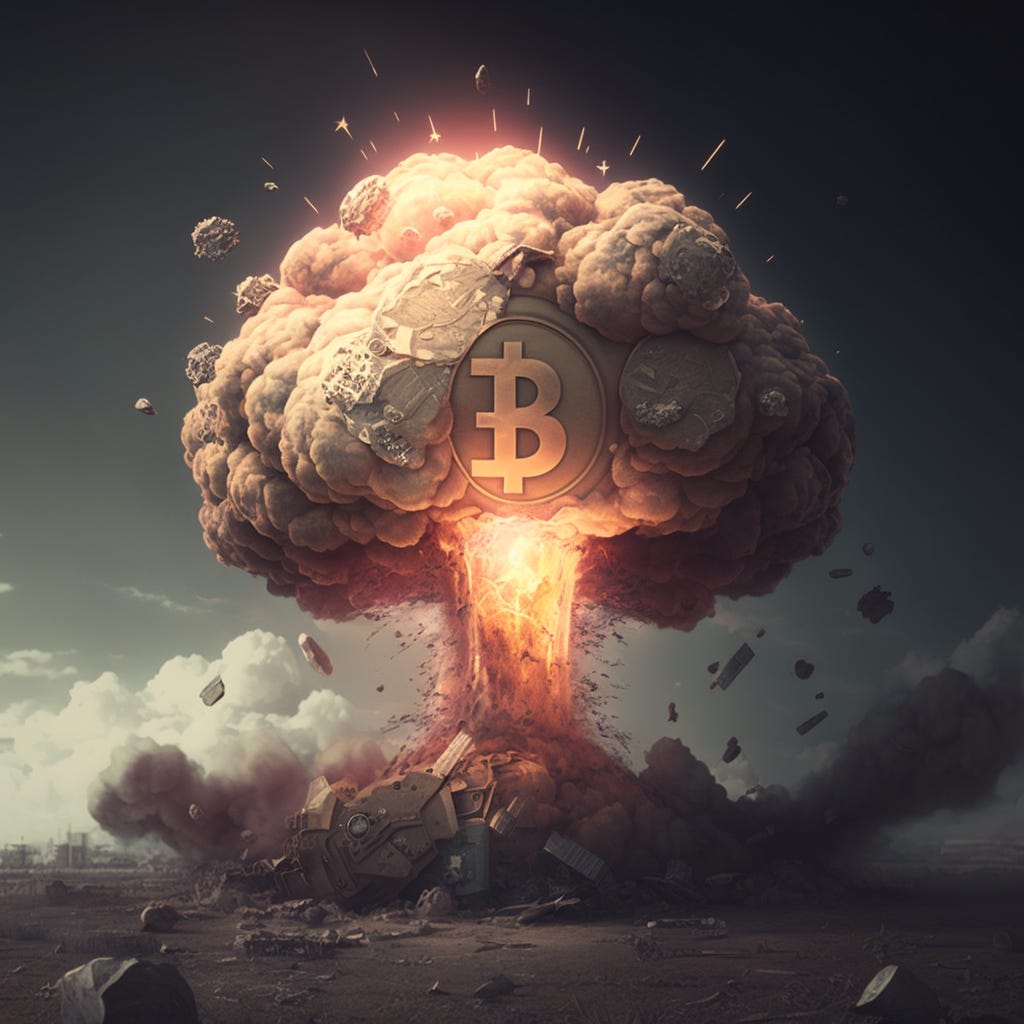
In the last few weeks the Crypto world was given two bookend world-views on Bitcoin, showcasing two extreme polar opposite views. On one end we had the publication of the long awaited MIT masters thesis (Softwar: A Novel Theory on Power Projection and the National Strategic Significance of Bitcoin) by US Space Force Major Jason Lowery, a US National Defense Fellow at MIT who views Bitcoin as one of the great advancements in humanity, and a war-fighting and power projection instrument deserving of National Strategic attention.
On the other end we had Berkshire Hathaway’s Vice Chairman, Charlie Munger, who called in a WSJ opinion for America to broadly ban crypto, later underscoring his view on crypto in a CNBC interview where he referred to all cryptos as ‘crypto-crapo’, and explained that no good arguments existed in support of cryptos.

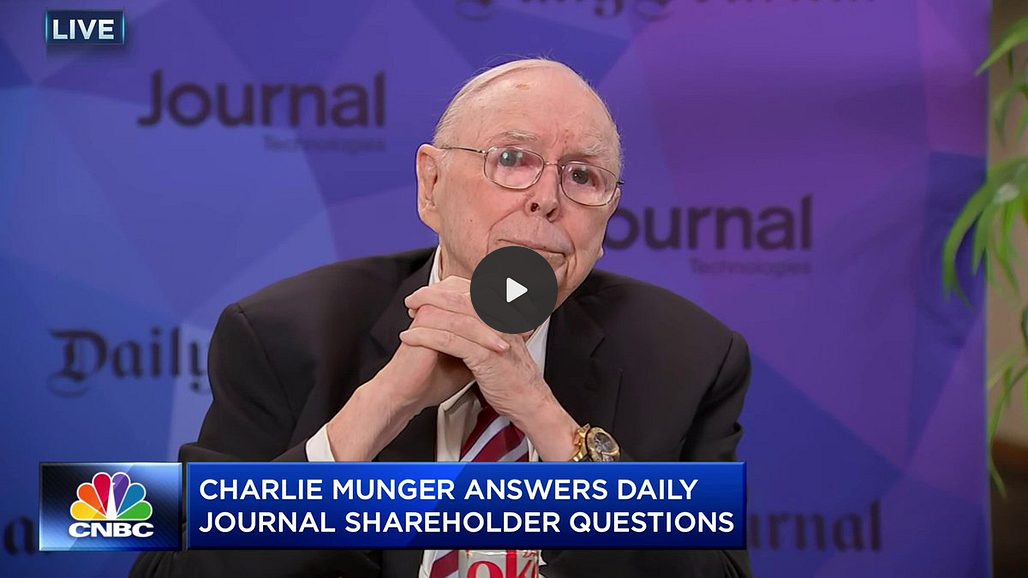
It’s disappointing to see a beacon of Reason like Charlie Munger not be able to articulate his opponents world view and resort to ad hominem attacks, but here we are.
No doubt part of the challenge for Charlie is that most views supporting Bitcoin come from the hard money monetary perspective that Charlie likely views as backward.
Separately, while Charlie has provided a number of negative views about Bitcoin, he hasn’t really explained his thinking in detail about why he views Bitcoin and cryptos so negatively, other than noting that Bitcoin and crypto more broadly are a playground for scammers and speculators.
In this article I’d like to help Charlie along a bit, by steel-manning his argument on Bitcoin and cryptos.
I’ve never met Mr. Munger, so in doing this I only have the public record that we all have access to. No offense is intended, and my hope is only to inform, entertain, and possibly enlighten.
Afterwords we can digest Lowery’s thesis, and then perhaps see how the two views might interact.
Let's begin.
Steel-manning Charlie:
Almost no one today has an appreciation for just how bad the Great Depression was.
The Depression cascaded through all aspects of American life and the global economy. Businesses and factories shut down. People lost their jobs and homes. The agricultural sector was hit especially hard, with farmers unable to sell their crops and many forced to leave their land. Many banks closed resulting in millions of people losing their life savings. The loss of trust in the banking system and the government's inability to address the crisis led to widespread pessimism and despair.
In addition to the economic impact, the Great Depression had a profound effect on the lives of ordinary Americans. Many families were torn apart as parents were forced to leave their homes and travel across the country in search of work. Children were sent to live with relatives or placed in orphanages, and many people became homeless and lived in shantytowns or Hoovervilles. Suicide rates increased, and many people suffered from depression and other mental health problems as a result of the trauma of the depression.
It took years for the economy to recover. It wasn't until the country's entry into World War II that the depression truly ended. Twelve years. Twelve years between the Black Tuesday crash on October 29th, 1929, and the US entry into the WWII following the attack on Pearl Harbor, December 7th, 1941.
Charlie lived this. Born in 1924 in Omaha Nebraska, he witnessed these events firsthand in the breadbasket of America, just as that basket ran empty.
Lost in the historical analysis of the Great Depression is the damage caused by the US’s Gold backed monetary system. Specifically by how much the French central bank’s repatriation of US gold added to the severity of the Great Depression. Even Milton Friedman, who originally failed to grasp the importance of the role that Gold played in causing the Great Depression, even he eventually acknowledged Gold’s position in the Great Depression towards the end of his career. (link)
Instead of seeking out a deep understanding of history, the naïveté of today’s youth is staggering. Fawning over Gold from an unearned and unwarranted nostalgia, they buy this Bitcoin stuff in the hope of what? …depriving the monetary authorities of the one tool that everyone agreed on in the aftermath of the Depression… that a flexible currency was a net benefit for humanity? Please.
More than just a net benefit. The outlawing of gold from private hands eventually put deposits into banks, where loans could be made to galvanize and revitalize the economy.
The Paradox of Thrift gives us an understanding that those deposits will be the same in amount wherever they eventually land, but with banks offering out loans we generated a higher monetary velocity, supporting a higher number of jobs, and ultimately the ability to support a larger population.
Some of those loans went to projects that advance industry, technology, and productivity, ultimately pulling innovations forward from the future in just the same way that other loans pull demand forward.

The combination of technology, jobs, and demand produced an increase in productivity and population which contributed to the staggering GPD growth we saw in the post War years.
Agentive. A flexible monetary policy and the move off of the gold standard put money in the hands of asset allocators instead of gold bugs.
Who would you rather have run your pool of insurance float? Yourself or Warren Buffett? Some people can’t even be honest with this question, but the right answer is Warren Buffett.
And what is the cost of this fountain of capital and wisdom? All we have to do is debase the reserve currency!?! Who cares!?! Eroding the reserve currency is what real leaders do damn it!
Indeed if you woke up one morning in the early 1950s, with total control over the World’s reserve currency and given the position of the United States at the time, you'd have a moral obligation to debase the Dollar! We didn’t need to until the early 70s, but this is how you have to think!
In short, a flexible monetary policy is an enormous benefit to humanity. Not only in allowing leaders to deal with crises when they come along, but in moving capital from the hands of gold hoarders, who likely aren’t very good at anything other than hoarding gold and digging around in creek-beds, to professionals whose job it is to allocate capital, and by extension to seek out those high quality capital allocators from society and put them into positions where they can do something productive for society.
Understanding Jason Lowery’s Thesis:
Where Charlie might see Bitcoin as a technology that aspires to the status of a monetary instrument, Jason’s perspective on Bitcoin starts with more fundamental questions about what Life is and what the role of Conflict is in the history of biology.
For Jason, Life is the collection of things that tilt at the windmill of the inevitable flow of entropy, the inexorable force behind the Second Law of Thermodynamics and the rule that at a universal scale disorder increases and order decreases.
All biological life compete on a battlefield of limited resources to impose their will over those limited resources. Fitness and environment select for the most able to harness those resources as all physical confrontation clear in the same dominance protocol, the Laws of Physics.
The Laws of Physics -not decision makers- are the final arbiter of every conflict, functioning everywhere and always in the same way regardless of existing players and the existing claims on the environment’s resources.
Patterns emerge in the strategies chosen by resource competitors, from single celled organisms, to multi-cellular organisms, to plants, to animals, to humans, a balancing act of conflict is performed between lethal conquest, like-kind collaboration, mutation, adaptation, gene selection, and senescence.
On occasion a species will find that it needs to establish an internal dominance hierarchy through nonlethal means. Wolves compete for the Alpha position without killing each other. Birds perform elaborate dances and produce exotic feathers to attract mates. And various hoofed animals grow antlers out of their heads to joust with each other.
For Lowery, Humanity today with the recent advent of nuclear weapons finds itself in a similar moment to those species. With nukes, traditional conflict has found a stalemated endpoint.
And while lower level proxy conflicts have occurred between superpowers and superpower supported countries since WWII, the technological developments on the modern battlefield push conflict towards ever more controlled means and increasingly non-lethal outcomes.
Perhaps future drone on drone conflicts between AI controlled drone swarms could be mistaken for non-lethal spectator sports. If so, what’s the difference between that and a video game? If so, what’s the difference between that and Bitcoin mining?
For Lowery then, this moment should spur on a new mutation in Humanity towards a non-lethal conflict resolution Domain, and in Proof-of-Work blockchains and specifically in Bitcoin, he finds it.

Synthesis: Entropy, information, and the nuclear question
The two questions that bubble under the surface of these two views are philosophical ones: ‘How does Humanity advance?’, and ‘What is the best way currently for Humanity to advance?’
For the second question, we can imagine that Charlie and Jason agree about one thing: Humanity cannot advance at all if the escalation of conflict ever reaches a nuclear war.
Where as Gold played a significant role in the cause and depth of the Great Depression, and the Great Depression gave rise to the demagogues that plunged Humanity us into WWII, we might see in Charlie’s thinking a concern about not bringing humanity any closer to a nuclear escalation through an irresponsible desire for hard money.
If the hard currency fetish of Gold was a domino in a path that led us all into WWII, and the likelihood of a new World War occurring that doesn’t escalate to nukes is small, then why should we seek out a hard monetary instrument like Bitcoin, arguably something that is even more deflationary than Gold, with any hope of a successful ending for Humanity?
Lowery here might point to the first question: ‘How does Humanity advance?’, and answer that for the last 5,000 years human civilization has advanced along a path of increasingly durable record keeping, record keeping better able to transmit information through an entropy-laden and increasingly adversarial future with the strongest signal.
From spoken words, to epic poems and song, to papyrus writing, to parchment, to printed words, to the internet, the arc of civilization bends towards those record keeping systems that can best catalogue the events of civilization.
Where Charlie might see extraordinary value in the flexibility that our current monetary policy system offers, Jason’s view is that flexibility is not the norm that we see in physics or biology and therefore should not be given priority in the soft war framework that we need to develop to stave off an existential conflict. Indeed it is not a mere preference, but an essential element of a future type of cyber defense.
Where as putting a human in the decision loop for future drone to drone Air Domain combat might seem clumsy, the idea of putting a human in the loop of battling cyber AIs would be debilitating for the AIs’ effectiveness. Yet allowing the AIs to run free without a tether back to a ground truth information state would invite a hall of mirrors type of cyber attack as one AI would seek to control the state of the an adversary AI with no way out for the attacked AI.
How then to establish ground truth in that future dystopian cyber battle between AIs? System states would be tethered back to the world’s most durable Proof-of-Work blockchain, a world computer, where ground truth of the most important computer systems would be embedded into a system that -heavy in energy expenditure- would elegantly still be susceptible to conventional military strike power projection.
But why not have a Proof-of-Stake system run the show? Why the focus on inflexible, energy intensive Proof-of-Work? Because the inflexibility, and the energy consumption are features, not bugs.
For Lowery, (as I understand him) Proof-of-Stake would be too vulnerable to the whims of the staking authorities of the given network, and too inscrutable from an intelligence collection perspective to disrupt. Proof-of-Work by contrast is more transparent; you can see where your opponent’s antlers are, and how many of them there might be.
As for how larger countries will ultimately deal with Bitcoin, the outcome remains to be seen.
Monetary and regulatory powers seem to have given clearer guidance about their distaste for Bitcoin than have the same country’s defense departments whose views remain murky. Murkiness on the Defense side may be by design though.
In Lowery’s view for a defense department specifically, it may be more important to leverage in the moment energy expenditure to write the next block of Bitcoin and to hold at risk a 51% threat over the chain itself, than to hold large quantities of the Bitcoin token.
Of course the mechanics of the Bitcoin system would still drive the paper value of a Bitcoin higher, and the need to facilitate transaction fees would always endure, but determining the transactions included in a block would be paramount for bedrocking the various important computer systems’s states indicated in the above scenario.
What then to do with the tokens?
… Perhaps the monetary authorities will think of something. In the mean time, it’s a good thing we can ram the antlers of these two sets of ideas together non-lethally.
Until next time.
-Jack
Jack … Here is another way to look at Charlie viewpoint. For all the reasons you outlined, gold was a poor reserve for capital formation. I don’t think we truely de-coupled until Nixon. The “faith” in a non-gold reserve economy was, IMO, on our ability our ability (US Goverment) to meet our financial obligations. The fiat currency (dollar), as the worlds base currency has largely satisfied that role. Charlie views the lack of stability, and baseline comprehension into how Bitcoin is created (away from the US Government), to be unsettling. More simply said, Bitcoin (or Crypto) need a better marketing campaign as to its benefits that currently are generally known, to gain widespread accceptance.