

Since the 1970s one debate has dominated Sci-Fi circles: Star Wars or Star Trek?
This Sci-Fi debate spilled over into the business world, appearing in job interviews (source) and business articles (source), and even serving as an ideologically defining question for PayPal Billionaire Peter Thiel (article).
From Zero-to-One by Peter Thiel with Blake Masters, page 122-123:
Max Levchin, my co-founder at PayPal, says that startups should make their early staff as personally similar as possible. Startups have limited resources and small teams. They must work quickly and efficiently in order to survive, and that’s easier to do when everyone shares an understanding of the world. The early PayPal Team worked well together because we were all the same kind of nerd. We all loved Science Fiction: Cryptonomicon was required reading, and we preferred the capitalist Star Wars to the communist Star Trek.
While Thiel’s distinction between Star Wars and Star Trek around capital allocation is intriguing, the differences between the two Sci-Fi franchises (and indeed all Sci-Fi stories) might better be understood through the lens of Malcom Gladwell’s framework for understanding crime thrillers. (Article)
In Gladwell’s framework there are four types of thriller stories: Westerns, Easterns, Northerns, and Southerns.
You might imagine Gladwell’s framework as a two-by-two matrix where one axis shows if the Rule of Law exists ( which Gladwell refers to as ‘Law and Order’), and the other axis shows if institutions are Righteous or Corrupt.
Westerns as a genre are what you might expect. Gladwell explains this traditional understanding of Westerns as a world in which “there is no Law an Order and a man shows up [an Outsider] and [Righteously] imposes … Law and Order on the territory.”
In contrast to Westerns Gladwell explains there are also Easterns. An Eastern in his formulation is a story where “there IS Law and Order, there are institutions of Justice, but they [the institutions] have been subverted by people from within.” The Hero, an insider, has to fix the Corrupt broken system to a Righteous one. An example being the film Serpico.
A Northern is where “Law and Order exists and Law and Order are morally Righteous. The system works.” The television show Law and Order being an example of this kind of story.
Lastly, a Southern is where “the entire apparatus is corrupt and where the reformer is not an insider but an outsider.” “All John Grisham novels are Southerns”, as a set of examples.
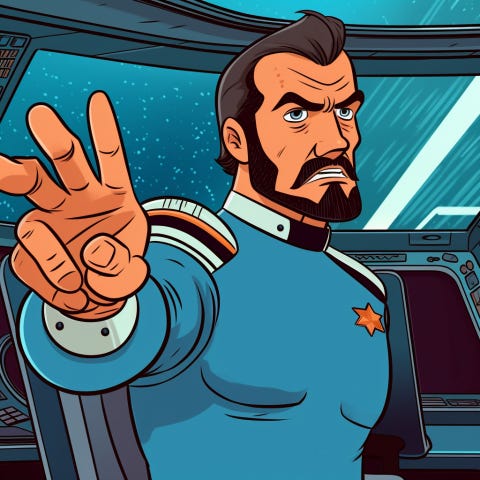
Space Westerns vs. Space Northerns vs. Space Southerns
Returning to the comparison of Star Wars and Star Trek we can think about how both might fit into Gladwell’s framework.
Star Wars is famously a Space Western, but Star Trek can now be seen as a Space Northern:
Space Western: Original Star Wars (Episode 4) - Lawless Galaxy. Reformer is an outsider from a backwater planet.
Space Northern: Original Star Trek and Star Trek Next Generation (not discussing DS9 here) - The United Federation of Planets exist and is morally Righteous. Hero characters come from within the organization and are measured by how well they work within the system. Information is preserved in Captain’s Logs, and official communications.
Space Eastern: Dune - Corrupt Imperium. Reformer, Paul, is an insider. Information is massaged as needed by the Emperor (Imperial Sardaukar in the Harkonnen’s attack of Arrakis).
Space Southern: Aliens - Corrupt primary organization. Outsider hero (Ripley). Information decay occurs regularly.
Star Trek feels like the ‘Northern’ show Law and Order in that the bias of most of the characters in the show is towards the righteous use of their capabilities within well functioning organizations. By contrast in the Aliens Franchise, some character or company is always attempting to bring a sample Xenomorph specimen back to Earth for examination at the risk of the rest of the crew, and Earth broadly.
Information loss vs. Information preservation
Why are the Universes of Star Trek and Aliens so different? Both imagine Humanity out a few hundred years from present day. Both engage with Alien races, cyborgs, highly capable humans, and space travel.
What is the corrupting influence that is present in the Universe of Aliens, but different in Star Trek?
One explanation would be around how each Sci-Fi Universe treats information. In Star Trek the bias is towards information discovery and preservation, while in the Universe of Aliens the bias is towards information hoarding and often information loss.
Most Star Trek episodes reference the ubiquitous record keeping system of the Captain’s Log, and each friendly communication within the Universe provides a near complete update on the relevant information to the ship or to the Federation.
Meanwhile Ripley, the main character of the Aliens franchise, drifted through the solar system in hypersleep for 57 years between the first and second movie because no one knew her shuttlecraft was there.
The tagline for Alien was “In space no one can hear you scream”, fitting for a Universe where information decays rapidly.
Back to the Future
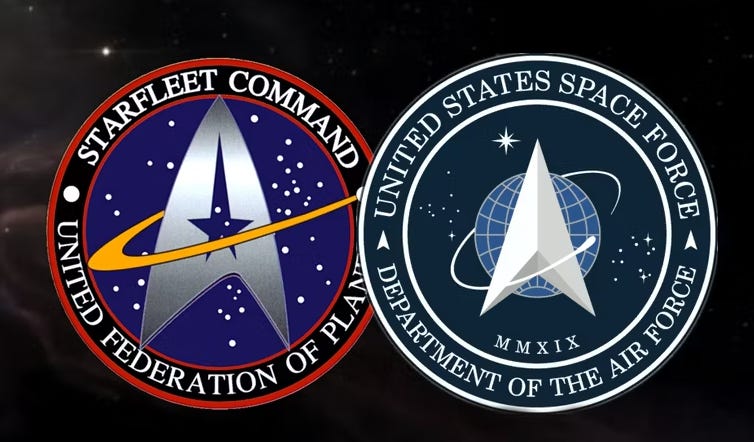
Do we have an information preserving Captain’s Log?
Well, recently US Space Force Major Jason Lowery, a US National Defense Fellow at MIT published his Master Thesis: ‘Softwar: A Novel Theory on Power Projection and the National Strategic Significance of Bitcoin’ (link). And buried in the 400 page tome is the idea that Proof-of-Work Blockchains like Bitcoin should backstop the entire Cyber Domain.
Can Bitcoin protect Humanity from the Xenomorphs? Probably not. But maybe it can make Dune into Star Trek.
Until next time.
-Jack
This is fantastic.