

The US has a Treasury problem.
China is selling its US Treasuries. Central banks are buying gold. But the US keeps issuing more debt every quarter.
So who buys the US debt?
The best case scenario is an odd one: An AI productivity miracle, plus exploding use of stablecoins via AI agent-to-agent commerce, plus the US Treasury twisting into the long end.
That sounds like science fiction. It isn’t, quite. Most of the pieces already exist. What doesn’t exist yet is the scale.
This is the first essay in a new series we’re calling The Golden Path that will outline the best case scenario for the future of the US.
Why “The Golden Path”
In the science fiction novel Dune by Frank Herbert, the Golden Path is the narrow route through a series of catastrophes to ensure human survival, a course initially foreseen by the main character, Paul Atreides, and later forced upon humanity by his son, Leto Atreides II. Most paths fail. One doesn’t.
The US debt situation looks a bit like that to my eye. Most of the scenarios end badly - an inflation spiral, financial repression, a failed auction, or a long grind of high rates that crowds out everything else. This series is about the narrow path that doesn’t end badly, and it will name the strongest case against that path every step of the way.
Elon Musk, no stranger to science fiction, put it bluntly this month: “The only way we’re going to solve the national debt is with AI and robots.” I think he’s half right. AI and robots can grow the economy, but someone still has to buy the debt in the meantime, and that’s where this series is headed.
Here’s my version of the thesis: AI has to work, and work in a big way.
Other ideas might help but each is problematic:
Fiscal reform is politically unworkable.
Revaluing gold would provide an asset windfall for the US, but does not balance the budget.
A large amount of printing pays the debt with cheaper money, but comes with inflation.
Reworking bond payments lowers the interest expense, but would rightly be considered a partial default.
A rapid decline in the number of benefits receivers would help the annual budget, but would come only from a handful of nightmare scenarios.
In the past, a global recession would cause foreign investors to fly to the safety of US Treasuries up and down the curve, but that potential gets trickier when the US is expected to print its way out of any problem, and rates are starting to climb.
Some mix of these will probably happen anyway. AI agents are the path that gets us part of the way there with the most winners.
The challenge is that AIs will need money they can actually use: programmable, always on, internet native. Dollar stablecoins fit that need. Stablecoins, by law, will have to hold short-term Treasuries. That gives the US Treasury new structural buyers, and over time a way to take pressure off long-term rates through twists and other mechanisms.
Let’s walk through it.
The buyer problem
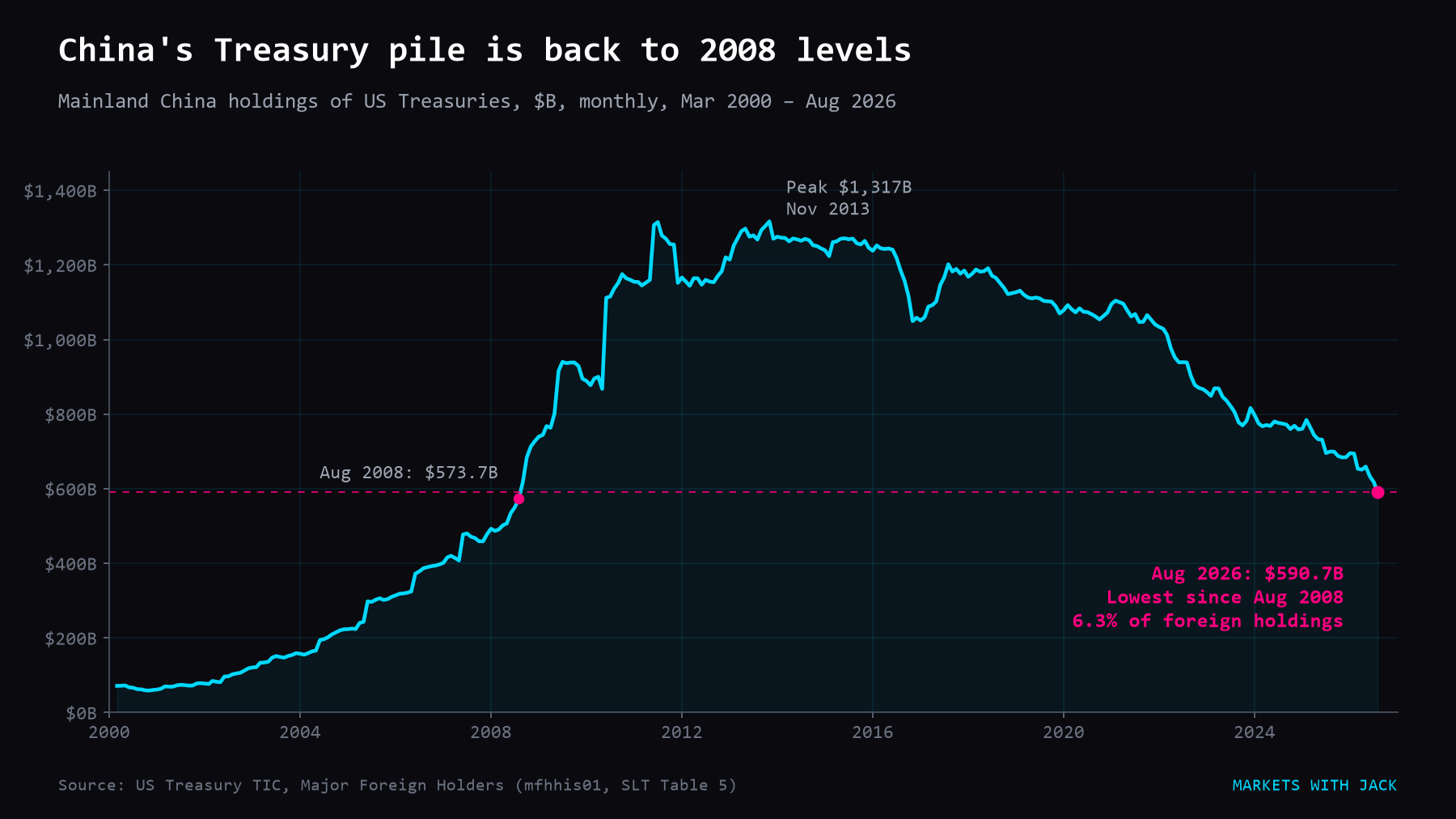
In my most recent monthly Compass I wrote how China had cut its Treasury holdings back to 2001 levels while central banks keep adding gold to their reserves. To be more precise on China: its holdings, at $591 billion in August, are the lowest since 2008, and its share of foreign-held Treasuries is back to where it was in 2001:
The bond market has noticed. The 30-year Treasury yield closed at 5.67% on October 7, its highest since 2002, and was still at 5.43% on October 16.
In the US, the Treasury is quietly telling us all to watch auction sizes. In its August refunding statement, Treasury said it expects to keep coupon auction sizes unchanged “for at least the next several quarters,” and that it is “monitoring SOMA purchases of Treasury bills and growing demand for Treasury bills from the private sector.”
The developing story is that the US Treasury is noting that if long-term buyers are scarce, the easiest place for Treasury to lean is bills, the short end:
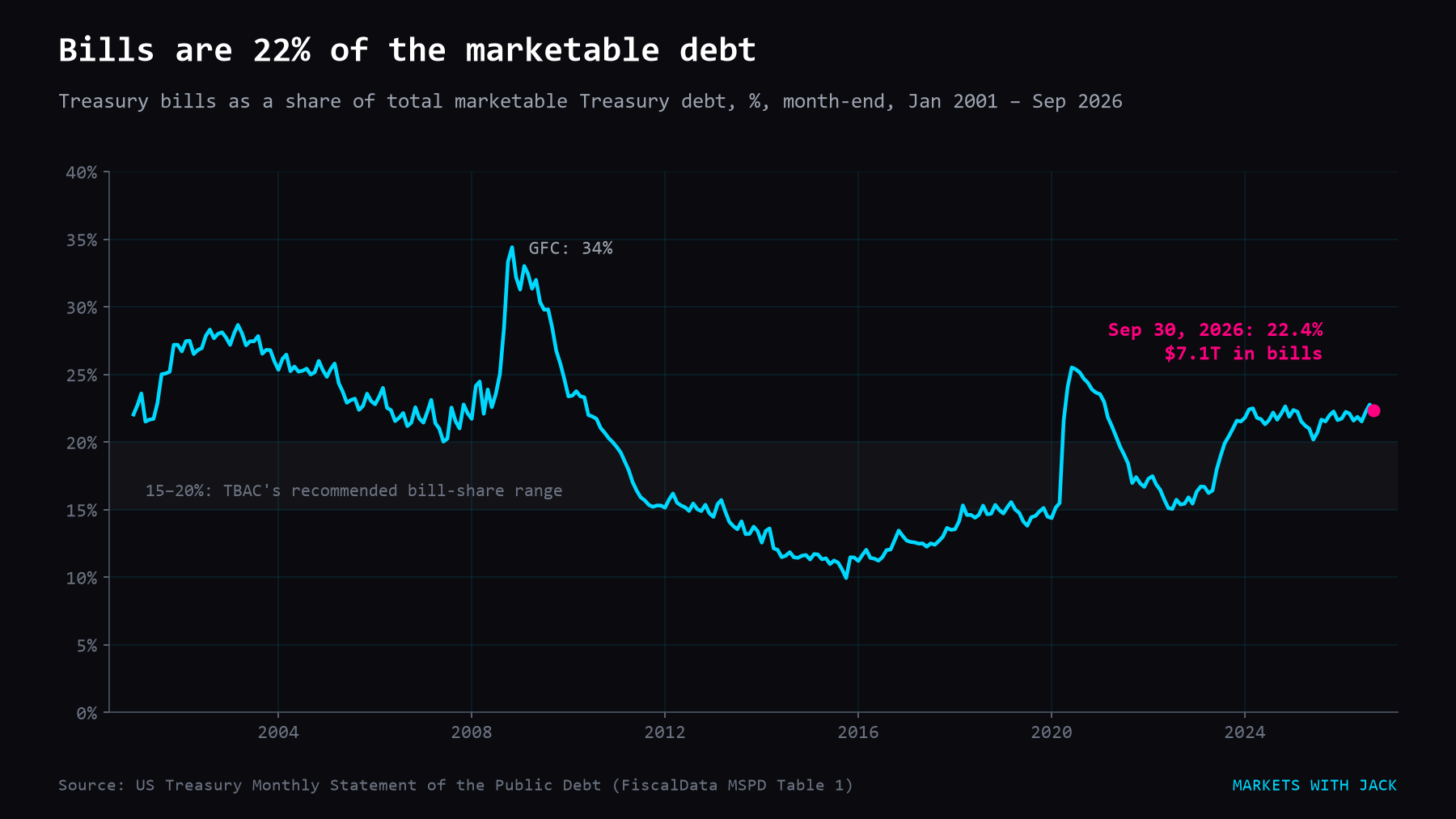
But leaning on bills only works if someone wants to keep buying bills, quarter after quarter. And the Treasury’s advisory committee noted in August that the funding gap “begins to widen in FY27 and increases further in FY28.”
So the question is less “who buys the debt today” and more “who becomes the new, reliable buyer of short-term US debt over the next decade.”
Stablecoins are already that buyer
Stablecoins are already a meaningful buyer of Treasury bills.
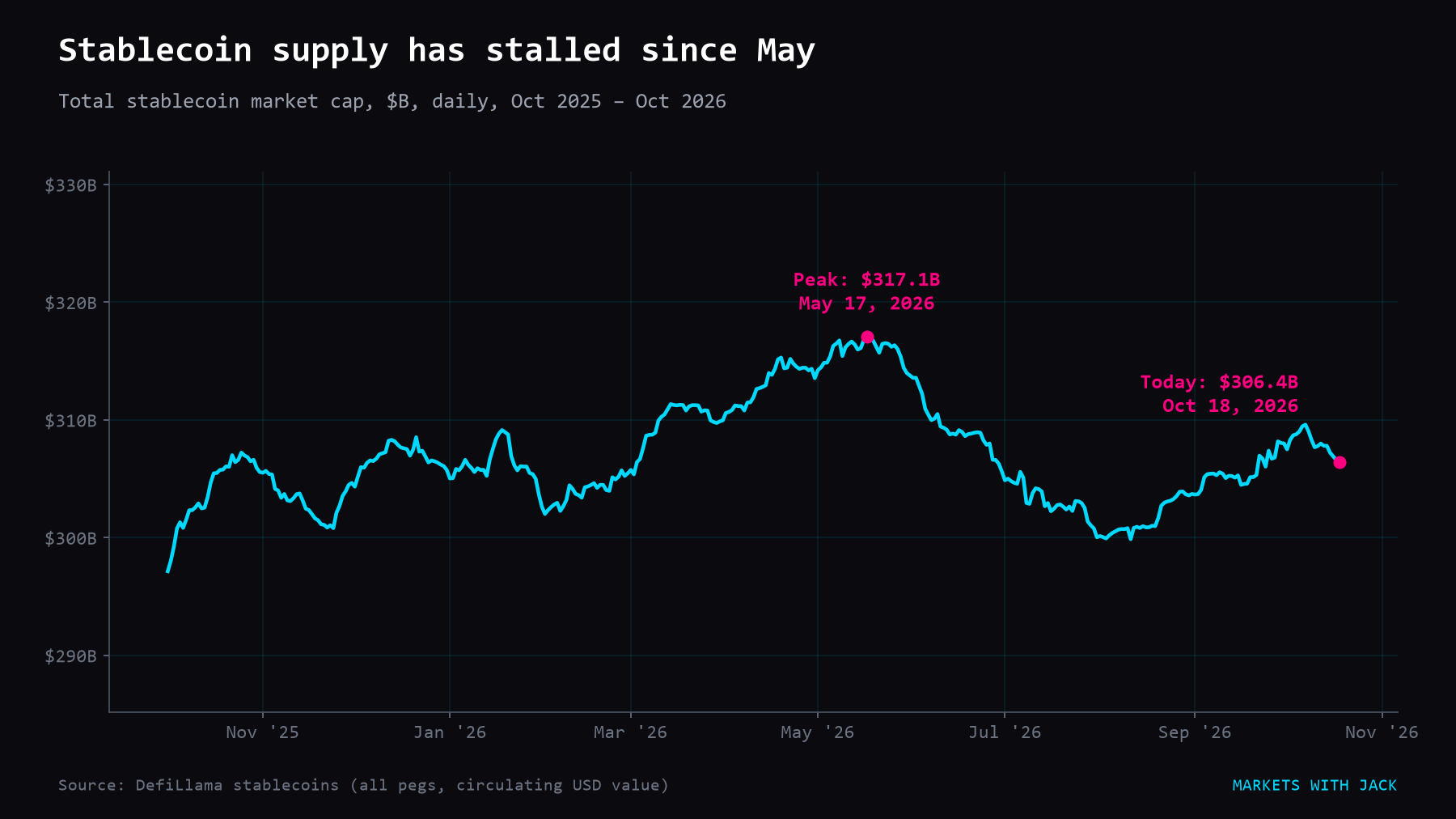
Total stablecoin supply is about $306 billion as of October 18, per DefiLlama:
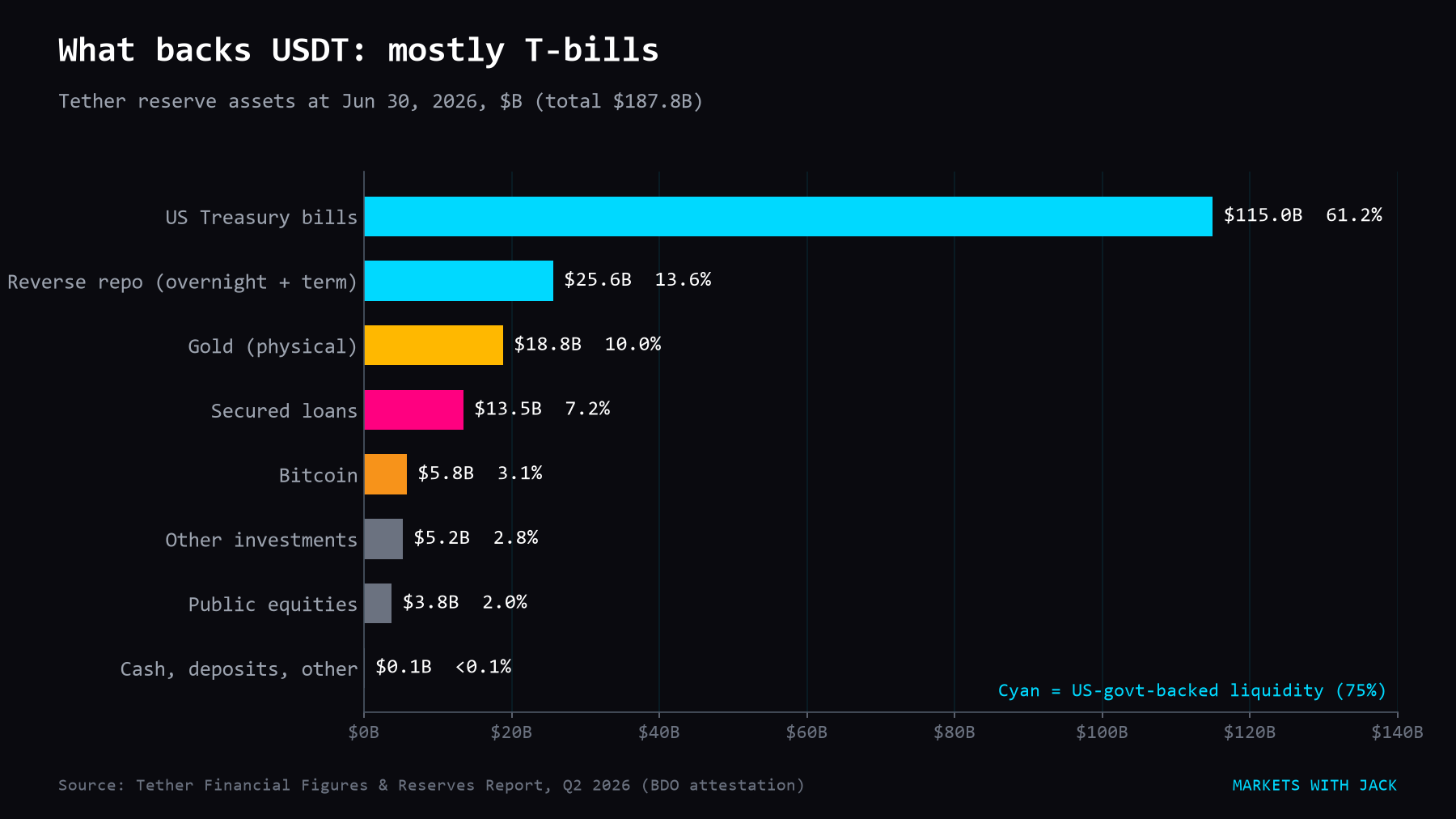
Tether, the largest issuer, held $114.96 billion in Treasury bills plus another $25.62 billion in reverse repo as of June 30, out of $187.75 billion in total reserves:
Circle, the issuer of USDC, reported about $73.0 billion in reserves as of October 12, mostly overnight Treasury repo and Treasury bills under three months.
The Bank for International Settlements (BIS) estimates stablecoins bought nearly $35 billion of Treasury bills in 2025, which it describes as similar to the largest US government money market funds. The same research finds that a $3.5 billion inflow into stablecoins lowers three-month bill yields by about 4 basis points within ten days. That’s small today. But stablecoins are roughly a $300 billion market, and if AI agents push that into the trillions, these modest effects start to add up across the front end of the curve.
That’s a new class of buyer showing up in the plumbing.
The law is turning them into structural buyers
The GENIUS Act, signed in July 2025, sets the rules for dollar stablecoins in the US.
The short version: issuers must hold reserves at least one for one for the stablecoins they create. Those reserves have to be things like cash, bank deposits, Treasury bills with 93 days or less to maturity, overnight repo, and government money market funds. The reserves can’t be pledged or re-used. Issuers have to publish their reserves monthly and have them examined by an accounting firm. And under Section 4(a)(11), issuers can’t pay holders interest or yield just for holding the coin.
The interest ban keeps stablecoins as payment money rather than a savings account, so they don’t compete with US bank deposits. It also means the issuer, not the holder, earns the Treasury yield. Issuers have every reason to keep holding bills.
One honest caveat: the law isn’t fully in force yet. It takes effect on the earlier of 18 months after enactment, which is about January 18, 2027, or 120 days after regulators finalize their rules. As of today, the Treasury, the Fed, and the OCC have only proposed their main rules.
Why AI agents are the engine
So we have a buyer in stablecoin issuers, and a law that pushes that buyer toward bills. What makes it grow?
To my eye, it’s AI agents.
An AI agent can reason, plan, and act. What it can’t easily do is fill out a credit card form, pass a bank’s identity checks, or tap “approve” in a banking app. But it can hold a wallet and pay in a stablecoin.
AI agents now use more AI than people do. On OpenRouter, agent token usage passed human usage in February and was about five times larger by August, up 14x in six months. That is the expansion this potential wave of new commerce would ride.


The rails for this are already being built by some of the biggest names in tech and payments:
Coinbase launched x402 in May 2025. It lets software pay for things over the web with stablecoins, using the long-dormant “402 Payment Required” code.
Google announced its Agent Payments Protocol (AP2) in September 2025, with an x402 extension for stablecoin payments.
Stripe and OpenAI released the Agentic Commerce Protocol in September 2025, which powers checkout inside ChatGPT.
The chain of logic runs like this. More agent activity means more stablecoins held as working balances. Under the GENIUS Act, more stablecoins means more Treasury bills held in reserve. More reliable bill demand gives the Treasury room to keep funding at the short end and hold back on long-dated issuance. And less long-dated supply is one of the few levers that can take pressure off long-term rates.
Treasury Secretary Bessent has called a $2 trillion stablecoin market by 2028 “reasonable.” The Treasury’s own advisory committee looked at a similar path in 2025 and put the implied extra demand for Treasury bills at roughly $900 billion. Standard Chartered still expects a $2 trillion market, but this month it pushed its date back from 2028 to 2030 because supply has stalled. Citi’s bull case goes further, to $4 trillion by 2030.
The second and third drivers: Eurodollars come onshore and inflation hits globally
There’s a second engine here that I wrote about a year ago in How to Think About Stablecoins.
For decades, a huge amount of dollar lending has happened outside the US, in what’s called the Eurodollar system. It runs through foreign banks, largely outside US regulation, and it’s notoriously opaque. The BIS puts dollar credit to non-bank borrowers outside the US at about $14.7 trillion as of March 2026.
My argument then, and now, is simple. If even a slice of that offshore dollar activity moves to fully backed stablecoins, the backing has to sit somewhere, and under US rules that means Treasuries and cash. Stablecoins are about $0.3 trillion. The offshore dollar system is about $14.7 trillion. The room to grow is large.
The third driver is savers in high-inflation countries, who could use dollar stablecoins to protect their purchasing power. That only works if the dollar holds its value against their currencies. So the Golden Path needs some dollar weakness against things like commodities as the Treasury keeps issuing debt, but not so much that other currencies gain on the dollar.
Agents are the new demand. Eurodollars coming onshore and savers escaping inflation are old demand finding a new home. Each one helps, and together they’d be a big deal.
The strongest case against
Here’s the current critique: agent-to-agent commerce is tiny today.
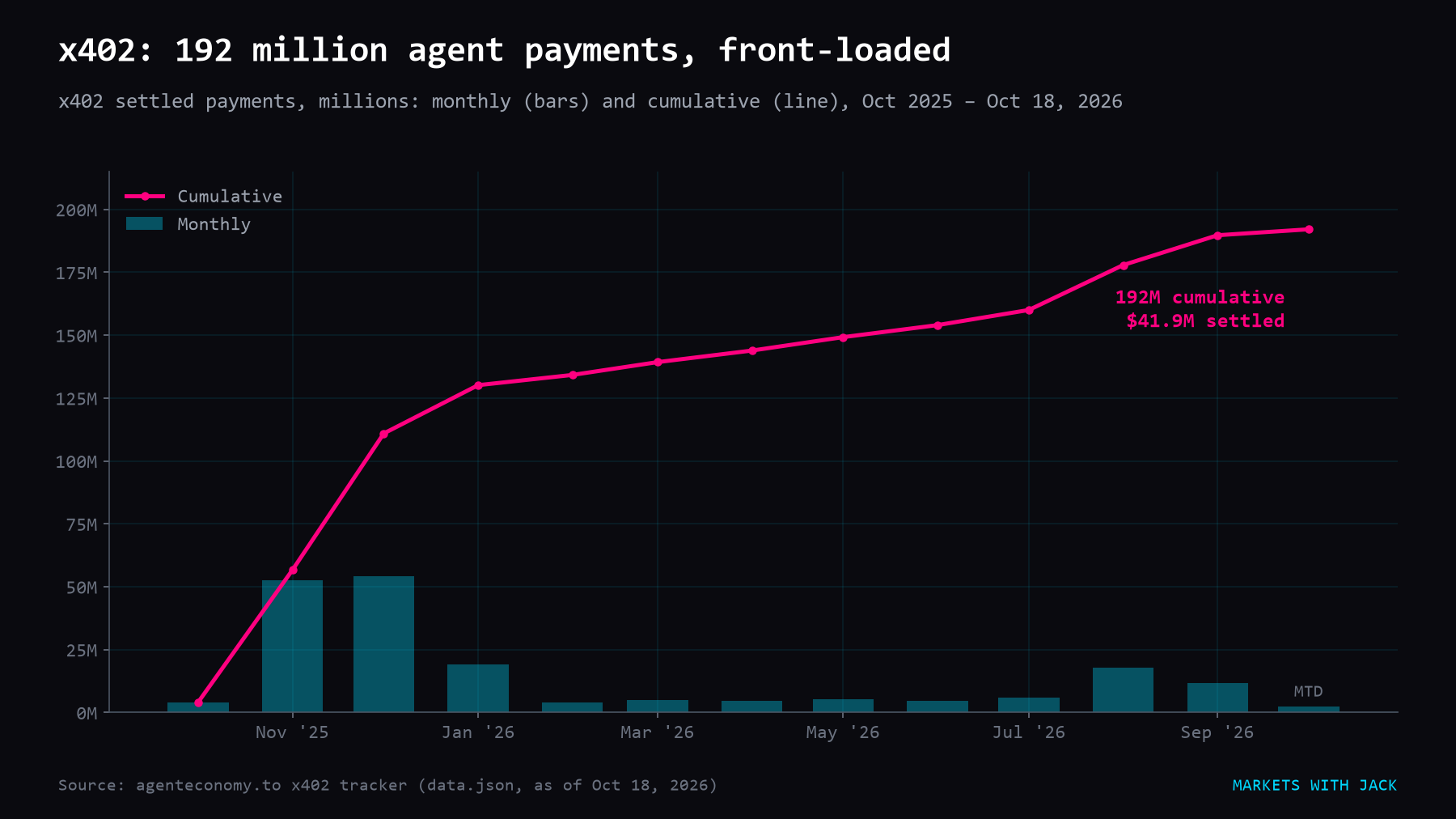
Total x402 settlement volume is about $42 million, ever, by one public tracker’s count, and Coinbase’s own figure was $53 million in late August. Even the most bullish agent forecast I can find, Gartner’s widely cited estimate of roughly $30 trillion of purchases made or influenced by machines by 2030, could just as easily run over cards as over stablecoins. Next to a stablecoin float of roughly $306 billion and about $7 trillion of Treasury bills outstanding, agent commerce barely registers yet.
And growth has stalled. Stablecoin supply is roughly flat from a year ago and is still below its May peak. The crypto bull run some of us expected didn’t happen.
Bills aren’t long bonds. The same BIS research that finds stablecoins push down bill yields finds no spillover to longer-term maturities. If you want lower 10-year and 30-year rates, buying three-month bills doesn’t get you there directly.
And as I noted in this month’s Compass, we might still see a major inflation scenario play out before any of this matters. Too little, too late.
My answer is that the effect on long rates is indirect, and it runs through supply. If the private sector reliably absorbs more bills, the Treasury can issue fewer long bonds than it otherwise would. That’s a slow lever, not a fast one, and I’m stating it as a leaning, not a certainty.
Where this goes next
That’s the path in outline. Over the next eight weeks we’ll walk it piece by piece: the issuers, the law, the payment rails, the refunding and the long end, and then what’s on the other side - AI in medicine, the good side of labor displacement, and post-scarcity economics.
We’ll also run a set of Failure Mode pieces, because a Golden Path is only worth anything if you know how it breaks.
For paid subscribers, the Monthly Market Compass tracks this path every month: stablecoin supply, the bill share, and the 10yr and 30yr.
Until next time.
These notes are not investment advice and are for informational purposes only. Always do your own research.